Rumelt Advisory
Strategy is more than ambition. It is the focused application of strength against critical challenges.
THE SOLE ADVISOR
I advise personally. I do not bring implementation teams, junior associates, or standard templates. I bring the discipline of an outsider’s eye to your most critical strategic issues.
THE ENGAGEMENT
True strategy does not start with your goals; it begins with your reality.
Our work together starts with Diagnosis. The first look is wide—examining competitive forces, technological shifts, legal constraints, and your internal capabilities—and weighing them against your ambitions. I look for the forces and inconsistencies that others ignore.
From this comes clarity. Every organization has problems, but only a few are strategic—ones that are both critical and addressable.
Among these lies the Crux: the single, pivotal challenge that blocks your path. This is the knot that must be untied.
As climbers say: “If you cannot surmount the crux, you cannot do the climb.”
Once the Crux is isolated, I advise on the concentration of effort required to overcome it—helping you design specific policies and concrete actions to turn insight into leverage.
THE FOUNDATION
“A giant in the field of strategy.”—-McKinsey Quarterly
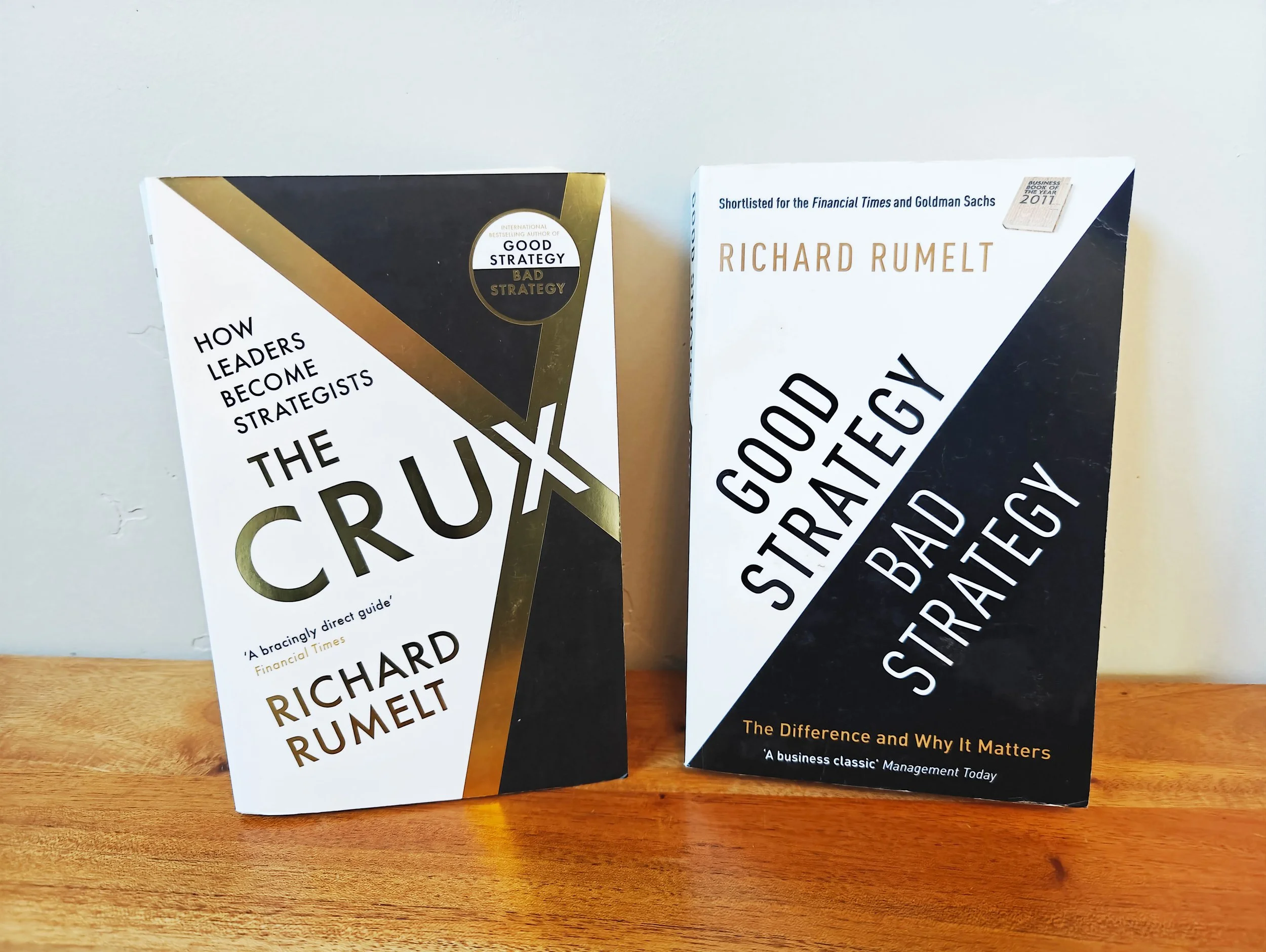
Rumelt, Richard. Good Strategy, Bad Strategy: The Difference and Why It Matters. New York: Crown Business, 2011.
Rumelt, Richard. The Crux: How Leaders Become Stratgegists. Profile Books, 2022.
THE ADVISOR

Richard Rumelt is the principal of Rumelt Advisory.
Described as "strategy’s strategist," he has spent four decades dismantling the fluff that passes for strategy in the corporate world. He is the author of Good Strategy/Bad Strategy—widely regarded as the definitive work on the subject—and The Crux: How Leaders Become Strategists.
Richard Rumelt began his career at the Jet Propulsion Laboratory, working on the Voyager mission to the outer planets. This early exposure to systems engineering—where a single error spells failure—formed the basis of his rigorous approach to business: the insistence that strategy must be a coherent design, not a loose collection of aspirations. Later, he received his Doctorate from the Harvard Business School, where he taught before moving to UCLA, where he is Professor Emeritus.
He has advised organizations worldwide, including AT&T, Shell, Microsoft, Telecom Italia, Commonwealth Bank, the DIA, the NSA, and many others.